
Whenever scientists find evidence that some new plant molecule (or phytochemical) is healthy, a ‘superfood’, that it prevents cancer, or helps you lose weight, what’s the first thing we do? We make a pill out of it.
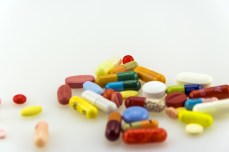
Red wine might prevent heart disease? Resveratrol pills! Fatty fish prevents cancer? Fish oil pills! Green tea? Catechin pills! Turmeric? Curcumin pills! And on, and on, and on.
Broccoli is one of the most recent foods to receive this treatment. Researchers found that a sulfur compound in broccoli, sulforaphane, has anti-microbial properties and kills cancer stem cells. It also increases liver enzymes that are known to be helpful against cancer.
So, what happens? A pharmaceutical company makes a pill, called Sulforadex, chalk full of sulforaphane. Perhaps unsurprisingly, it’s not even the first ‘broccoli pill’ on the market.
Now you might say, so what? My grandma told me to eat my broccoli when I was five years old. She knew this, why do we even need this research? Well, as people of science, we know that data are better than anecdotes. We also know that although our ancestors’ oral traditions often contain a great deal of wisdom, other times they are nonsense. So, I think it’s great that this research is being done.
The part that bugs me is that compounds that appear curative from research that is often funded by taxpayers must immediately be broken down into pill form and monetized. Many times in the past such pills have failed to fulfill the incredible promises made by their creators. Whether this was because the compound easily oxidized outside the plant (for example, catechins in green tea) or because it required a combination of other micronutrients present in the actual plant is interesting, but not super relevant. So, why does this keep happening? The answer is basically this: broccoli does not have lobbyists, red wine cannot be patented, whole blueberries can’t be crammed into a massively overpriced pill that everyone will buy and nobody will take.
I’m not saying the pills are bad for you. Some of them are smoke and mirrors, but some are likely effective supplements. But I know people taking a number of different supplements made from plant compounds like catechins, anthocyanins, curcumin, fiber, and many others. So, if you find yourself taking more than one pill that cost you a lot of money at GNC, and cost the company almost nothing to make, why aren’t you just eating vegetables? I get it, it’s hard, it’s expensive. But is it really harder than driving to a totally different store? Is it really more expensive than supplements at a specialized health food store, MANY of which are over 50 dollars for a month’s supply for one pill? And are you even considering the fact that there are likely thousands of other phytochemicals in the vegetables that might be healthy too?
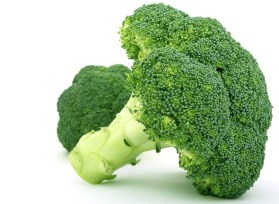
In other words, if there are enough healthy compounds in broccoli to make multiple different supplement pills, maybe even hundreds, why not just listen to your grandmother? Or if your grandmother didn’t tell you to eat your vegetables you can listen to mine.
Remember to eat your broccoli!
References
- Kim, BG, Fujita, T, Stankovic, KM, et al. 2016. Sulforaphane, a natural component of broccoli, inhibits vestibular schwannoma growth in vitroand in vivo. Scientific Reports doi:10.1038/srep36215
- Mahn, A., Reyes, A. 2012. An overview of health-promoting compounds of broccoli (Brassica oleracea) and the effects of processing. Food Science and Technology International 18 (6).
- Doss, JF, Jonassaint, JC, Garrett, ME, et al. 2016. Phase 1 Study of a Sulforaphane-Containing Broccoli Sprout Homogenate for Sickle Cell Disease. PLoS ONE 11(4): e0152895. https://doi.org/10.1371/journal.pone.0152895.


 My assistant brewer that day was my friend Trevor, who still hasn’t managed to come drink any since we brewed.
 tripel. I only have to make that comparison though because I’ve drank a lot more tripels than blondes. If you’ve never had one, Leffe blonde is probably the easiest to find, and is a great example of the style.
 hours), I moved it to the basement where ambient was 60F for about 36 hours until high krausen dropped, then moved it to my fermentation closet with a plant mat to try to get it up to 75F until fermentation was completely done (about 6 days). I use a similar temperature profile, with some variation, with most beers I brew, but especially Belgians. The reason why this is important is that by starting out fairly cool during the most intense fermentation, one prevents high concentrations of hot fusel alcohols, as well as other problems like band-aidy flavors. But heating up the fermentation as it starts to cool ensures that your fermentation will finish strong, and you’ll get a nice dry finish to your beer, which as I talked about before, is so critical with Belgian brews.


 beers, or very hoppy beers, but some of the people I drink with, especially my father and father-in-law, prefer light beers. Technically, a beer can only be called a Kölsch if it’s brewed in Cologne, Germany, but I’m pretty sure this only applies to commercial beers. If I’m wrong then I guess I’m brewing a “Kölsch-style beer”!


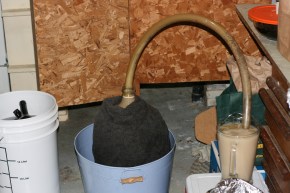 f tubs, and even when brewing a big Russian imperial stout on a yeast cake froma previous beer the Fermcap S kept me from needing to use a blow-off. But for some reason with this Kölsch yeast I needed a blow-off for nearly a whole week! So, be warned if you go to use Wyeast 2565 – it works great, but it creates a ton of krauesen, especially given how low gravity this beer was.







 Eli Swanson